

FoodExpo Qazaqstan 2026 ran from November 11 to 13 at the Atakent International Exhibition Centre on Timiryazev Street in Almaty. LAKEXIXI was in Hall 8 for all three days, with every series on the wall opened for tasting. Before the show we published a stand guide listing what visitors would find. This post is the other half of that story: how the shelf was built, what buyers asked once they stood in front of it, and which answers we could give on the spot versus which had to be sent as a document after the show.
The market we were walking into
Kazakhstan's food import bill reached roughly USD 5 billion in the first eight months of 2026, up 6.2% year on year, according to the national statistical agency. China supplied USD 407.6 million of that, 24.2% more than in the same period of 2025, which makes China the second-largest food source after the EAEU partners. The catch is duty: Chinese food enters under full customs duties, while Russian and Belarusian goods move duty-free inside the union. Buyers raised this without prompting. Almost every price conversation across the three days started from landed cost rather than from FOB.
The wall was organised by series, not by price
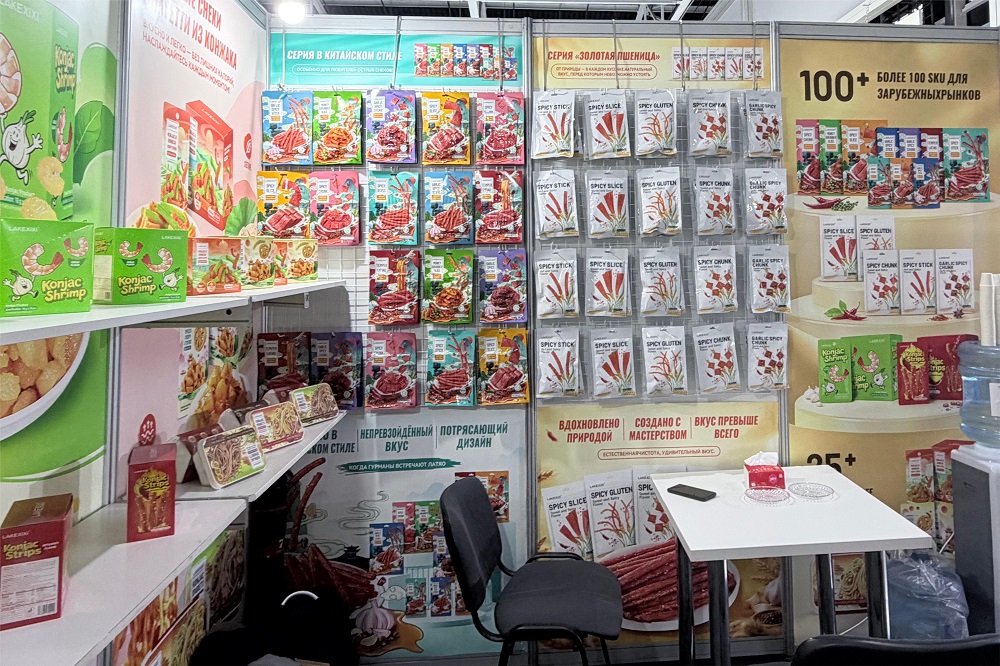
The stand carried two large Russian-language header panels rather than a price list. One read Zolotaya Pshenitsa, Golden Wheat, with five pack fronts arranged under it. The other read Seriya v Kitayskom Stile, the Chinese Style series, with ten.
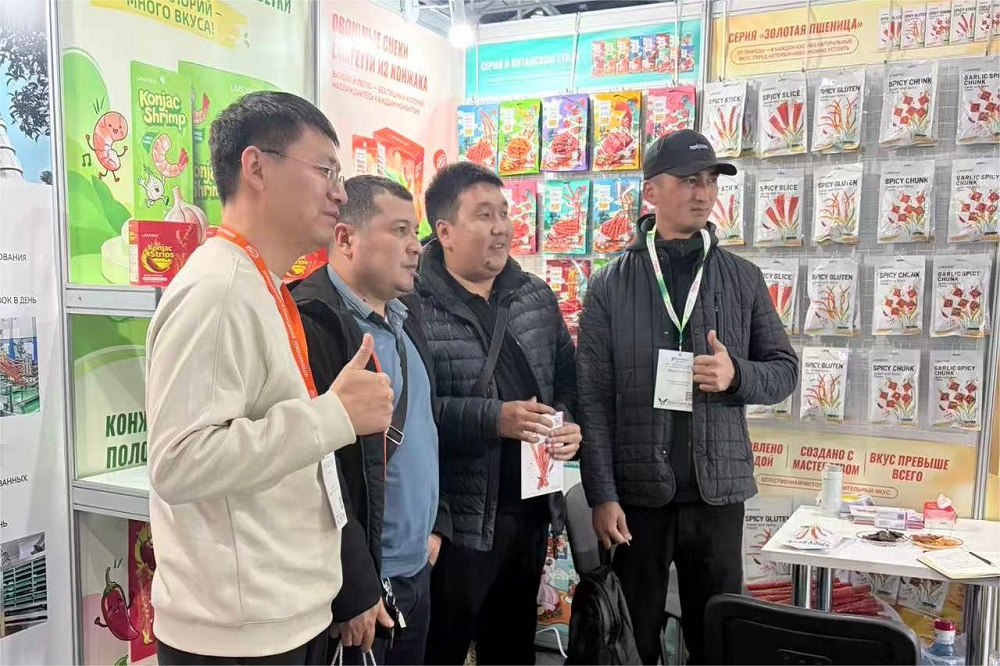
That layout did most of the selling. A visitor could read shape first - stick, slice, chunk, gluten - and the flavour line under each product name second, without anyone standing next to the shelf to explain it. The buyers in the photographs are doing exactly that: reading the wall, then lifting one pack off it.
The reason to merchandise by series instead of by price is simple. A price card answers the question the buyer asks at the end of the meeting. A series header answers the question he asks at the beginning, which is what this product is and where it would sit in his store. Two header panels, five and ten facings, and the category explains itself.
What was actually on the wall
Five groups, all opened for tasting.
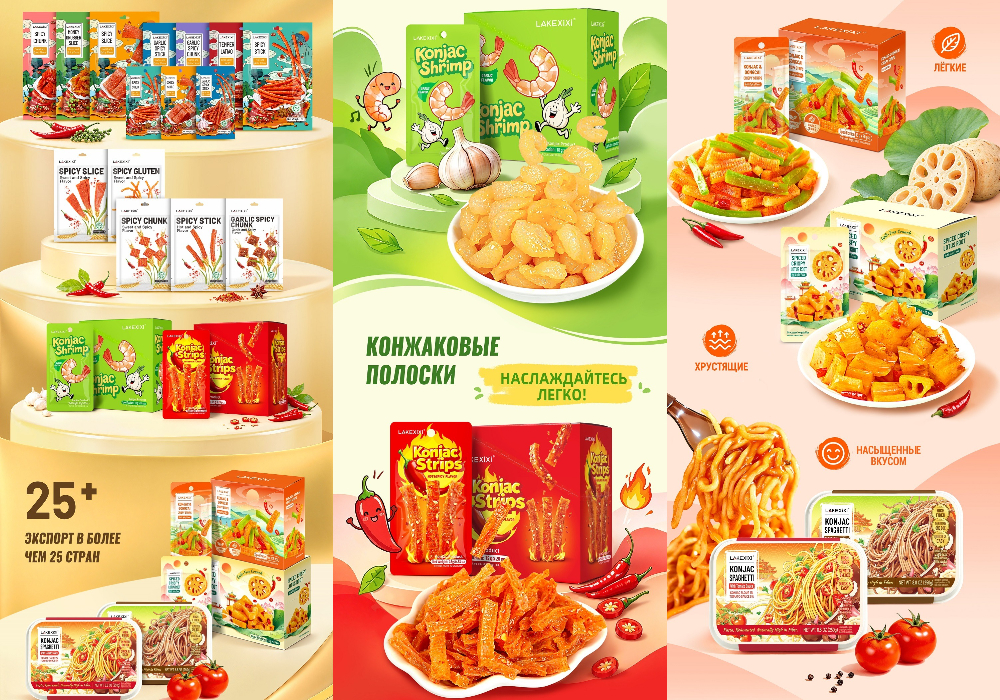
The Chinese Classic Series carries ten SKUs, mostly in 92g and 26g packs, with a 270-day shelf life and a listed minimum of 100 cartons per SKU. Spicy Stick and Spicy Slice exist in both sizes, Garlic Spicy Stick and Spicy Slice sit in 26g, while Garlic Spicy Chunk, Temper Latiao and Money Grubber Slice are 92g.

The Golden Wheat Series is the cleaner, newer line and the one we recommend first to a buyer who has never listed latiao. Five packs, all built on wheat imagery, four of them sweet and spicy - Spicy Slice, Spicy Gluten, Spicy Chunk, Spicy Stick - and one garlic variant, Garlic Spicy Chunk, sitting in the hot and spicy direction. Same 270-day shelf life. The naming is consistent and the flavour map is easy to explain to a retail category manager, which matters more than it sounds when the buyer has to justify a new shelf to someone else.

The VP Series is the vacuum-packed line: Spicy Wheat Snack Sticks in Mala Hot Pot flavour, plus sticks and slices in Sweet Chili and Cumin, all 92g, 360-day shelf life, V-Label vegan. For a Kazakh route this is the pack that tolerates a long rail leg best, and buyers who already import from China recognised the format as soon as they saw the seal.
Konjac Delight is three mini formats. Konjac and Gongcai 15g, hot and spicy, 270 days. Konjac Strips 15g, hot and spicy, 360 days. Konjac Shrimp 18g, garlic, 360 days. The shrimp shape is the one that reads as a snack rather than as a diet product, which is probably why it worked on a table full of chilli-red packs.
The konjac spaghetti line sits outside the snack wall: 250g boxes, tomato or black pepper sauce, three minutes to prepare. It is new for this market and it produced the longest conversations of the show, almost all of them about placement - pasta aisle or instant meal aisle - rather than about price.
Behind all of it, the certificate wall, visible rather than filed away: HACCP, ISO 22000, ISO 9001, HALAL, V-Label, next to the milestone line that puts export history at 25+ markets since 2025.
Question one: "Do you have EAC?"
Asked more often than anything else, usually within the first two minutes. EAC is the Eurasian Economic Union conformity mark, and an importer needs it before food can clear customs and before a chain will list the item. The honest answer is that a Chinese factory certificate does not replace EAC. EAC is applied for by the importer or by an authorised entity inside the union, and what the factory supplies is the technical input: product composition, process description, test data, packaging specification.
What we could hand over at the stand is the document pack a buyer needs to open that file: export food enterprise registration, batch certificate of analysis, heavy metal test report, microbiological test report, packaging material test report, certificate of origin, HALAL certificate, ISO certificates and a D-U-N-S number for supplier registration. Several buyers photographed that list instead of writing it down. That told us more about the market than any single question did: the checklist is the product, at least at the first meeting.
Question two: "Can the label be in Russian?"
Inside the EAEU, food labelling is governed by TR CU 022/2011, and the mandatory information has to appear in Russian or in the language of the member state. In practice there are two routes: Russian artwork printed at the factory, or over-labelling done by the importer after the container lands.
The trade-off is cost against speed. Factory-printed Russian film costs nothing extra per unit but locks the design into one language version and takes the full production window, about 35 days with existing artwork and about 45 days for a new design. Over-labelling keeps a single neutral film for every market but adds labour per carton and a second handling step before goods reach the shelf, and chain buyers tend to inspect that step. For a first container most buyers we spoke with preferred factory printing. For a distributor running several markets, over-labelling usually wins.
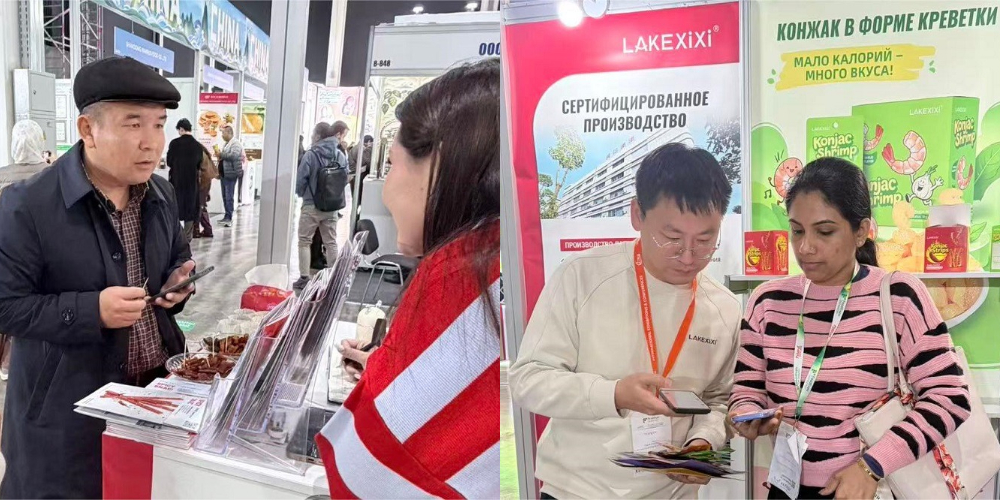
One detail worth repeating: our own stand panels were printed in Russian, not English, and they carried the sale. It is hard to argue for English packaging after watching that.
Question three: "What is the minimum order?"
There are two different minimums and mixing them up causes most of the confusion in first meetings.
For stock items the listed minimum is 100 cartons per SKU. That is a product-level figure, and it is why a first order tends to be narrow - three or four SKUs with real depth, rather than ten SKUs at 100 cartons each.
For private label the terms are different: around 700 cartons can run with no deposit, or from roughly 200 cartons with a deposit on the packaging materials, refunded in full when the run is completed. The logic is that film and cartons are ordered per design, and a 200-carton run leaves us holding material for a design nobody else will order.
Capacity is not the constraint in either case. The latiao plant runs 8 lines and 21 machines, up to 150,000 vacuum-packed units and up to 3,000 cartons a day, across three Class 100,000 clean workshops and 10,000 square metres of production area. The konjac plant runs 2 lines and 12 automatic machines, at 1.2 million packs a day standard and up to 1.8 million at peak. A trial order is a scheduling question, not a capacity question, and saying so plainly tended to change the mood of the conversation.
Question four: "How long does it actually last?"
The shelf-life answer depends on the pack, so the reply has to be specific: 360 days for the vacuum-packed VP line and for the two konjac formats packed the same way, 270 days for the rest of the latiao and konjac range.
The follow-up is always the same: how much of that survives the journey. Almaty is reached by rail through Dostyk or Alashankou, or by truck, and transit eats weeks before the container reaches a warehouse.
Shelf life is declared for unopened product stored dry and below 25C. A Central Asian summer is not kind to a container parked on a rail siding, so the useful question is not total shelf life but shelf life remaining on arrival. Our answer at the stand: size the order around the remaining life at destination, not around the label; the production date is printed on every pack; and on the vacuum line the seal is the critical part, so a pack that arrives without vacuum should be rejected at receiving rather than sold through.
Question five: "Is it halal?"
For buyers selling into Muslim-majority channels this comes early, and often before the price question. We hold a HALAL certificate, and the part worth explaining is its scope: it covers the products listed on the certificate, not the whole factory and not every SKU in the catalogue. So the check is threefold - the certificate is current, the product appears on the list, and the issuing body is one the buyer's market recognises.
V-Label vegan certification is a separate scheme with a separate scope, and the two do not substitute for each other. A buyer who needs halal needs the halal document with the right SKU on it; a buyer who needs vegan needs the vegan mark. Saying that out loud saved time, because most suppliers blur it.
What a tasting table actually does
Three days of tasting produced a predictable pattern. A buyer who has eaten half a stick stops comparing price sheets and starts asking about texture, oil level and repeat orders. The pack in the photograph being turned over in someone's hand is the moment the conversation moves from specification to shelf.
It also filters. Sweet and spicy sells faster than hot and spicy in this market, and the garlic variants split buyers along age lines more than any other flavour. Running a tasting table for three days gives you that map without a single questionnaire.
What we would change next time
Printing everything in Russian worked better than expected, and so did putting certificates on the wall instead of in a folder. Tasting worked as it always does.
Three things we would add. A printed Russian one-pager with the EAC document checklist, so a buyer leaves with a list rather than a promise. A price sheet by carton tier, since the duty disadvantage makes landed cost the real conversation and FOB numbers mislead. And a sample kit that ships by courier, because half of the follow-up conversations begin after the buyer is back at his office, and a kit that arrives in week one is worth more than an email in week three.
One more, aimed at importers rather than at us: ship the series header artwork as POS with the order. The two header panels did more work than any single pack on that wall, and an importer can rebuild the same shelf with them without commissioning a designer.
If you distribute snacks in Kazakhstan or elsewhere in Central Asia and want the document checklist, a price sheet by tier or a sample kit, write to exportation@relaqidu.com with your target SKUs and retail format. We will send the current specification sheet and a batch COA with the reply.